

A den is one of the most flexible rooms in a home, but it’s also one of the easiest to furnish badly. Too large a sofa and the room feels cramped.Too little storage and clutter takes over. The wrong layout, and a cozy retreat turns into a room nobody actually uses. The right furniture ideas for a den start with understanding what the space is for, then choosing pieces that fit its scale, its traffic flow, and how you actually spend time in it whether that’s reading, watching a movie, working from home, or unwinding after dinner.
This guide walks through the furniture every den needs, smart solutions for small dens, layout strategies, and the mistakes that quietly ruin an otherwise good room.
What Is a Den, and How Is It Different From a Living Room?
A den is typically a smaller, more enclosed room than a living room, often used for relaxed, everyday activities rather than formal entertaining. Living rooms are frequently the “show” room of a house, arranged for guests. Dens tend to be more personal a place for reading, watching TV, working, or hobbies, and they’re often located off the main living area or tucked near a bedroom.
That distinction matters for furniture choices. Because a den is used more casually and often has less square footage, furniture needs to work harder: pieces should be comfortable for daily use, scaled to a smaller footprint and flexible enough to support more than one activity.
Core Furniture Pieces Every Den Needs
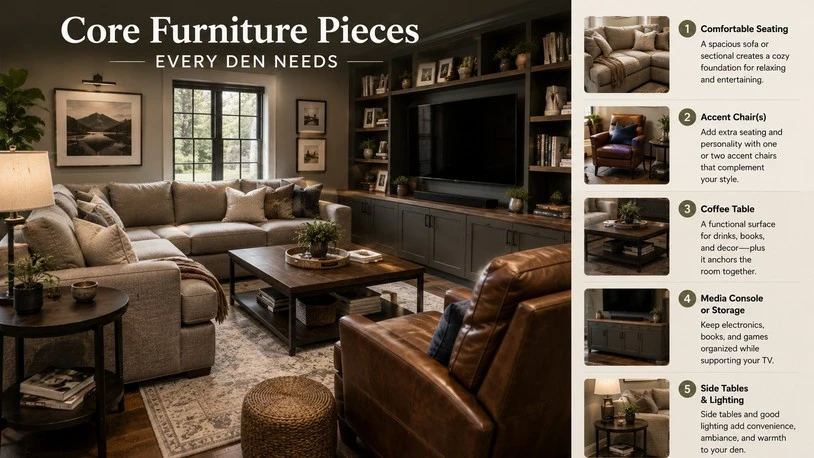
Regardless of size or style, most dens benefit from a version of these five furniture categories.
Seating. This is the anchor of the room. Depending on space, that could be a full sofa, a loveseat, a pair of armchairs, or a sectional with a chaise. The goal is comfortable everyday seating rather than formal stiff pieces meant for occasional guests.
Storage. Dens tend to accumulate books, remote blankets, games and work materials. Built in shelving, a bookcase, or a media cabinet keeps the room functional instead of cluttered.
Surface furniture. A coffee table or ottoman gives you a place to set drinks books or a laptop. Side tables next to seating add a spot for a lamp or a cup of coffee without reaching across the room.
Lighting furniture. Floor lamps and table lamps do more than overhead lighting to create the warm, layered feel most dens aim for, especially since dens are often used in the evening.
Task specific furniture. If the den doubles as a home office reading nook, or media room it needs furniture suited to that use: a desk, a dedicated reading chair, or a media console sized to the TV.
Furniture Ideas for Small Den Spaces
Small dens are common, and they call for furniture that’s scaled down without feeling like a compromise.
- Loveseats over sofas. A loveseat or a compact two-cushion sofa seats two comfortably without dominating the room the way a full size sofa can.
- Armless or slim profile chairs. Removing bulky arms from a chair design can save several inches on each side, which adds up in a tight layout.
- Nesting or stacking tables. These give you extra surface space that can be tucked away or spread out depending on need.
- Wall mounted shelving. Shelves that use vertical wall space instead of floor space free up the room for movement and seating.
- Multi-functional ottomans. An ottoman with hidden storage can serve as a footrest, extra seating, or a coffee table substitute useful in rooms where every piece needs to do double duty.
- Daybeds. A daybed can replace a sofa entirely, offering lounging space during the day and functioning as a guest bed at night.
- Corner furniture. Corner desks, corner shelving units, and curved sectionals make use of dead space that’s otherwise wasted.
- Furniture with exposed legs. Pieces raised off the floor visually read as lighter and make a small room feel less crowded than furniture with a solid base.
Den Room Design Ideas by Furniture Ideas for a Den
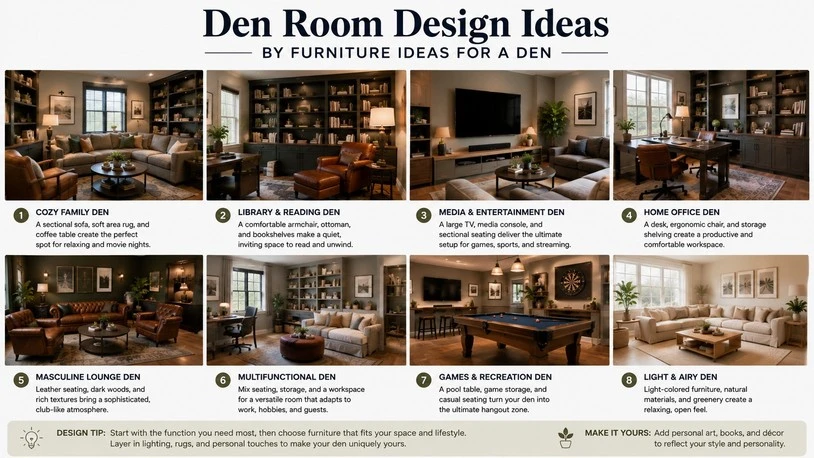
How you use the den should shape which furniture ideas make sense.
The reading den. A single well-cushioned armchair, a small side table, and a floor lamp with adjustable brightness are often more effective than a large seating arrangement; a low bookshelf keeps favorite titles within reach.
The media or TV den. Seating should face the screen at a comfortable distance, with a media console sized to the television and enough storage for remotes, gaming consoles, and cables a low coffee table works well for snacks during movie nights.
The home office den. A den that doubles as a workspace needs a desk with enough surface area for a monitor and paperwork, a supportive office chair, and closed storage to keep work materials out of sight when the room reverts to a relaxing space after hours.
The multi-purpose family den. When a den needs to flex between work play and relaxation modular furniture is the most practical choice: a sectional that can be rearranged, storage ottomans that double as seating, and a desk that can fold away or tuck into a corner.
How to Choose Furniture for a Den
A few factors consistently separate a den that works from one that doesn’t.
- Room dimensions. Measure the space, including doorways and windows, before shopping. Furniture that looks reasonably sized in a showroom can overwhelm a smaller room.
- Traffic flow. Leave enough clearance generally around 30 inches for people to walk through the room without squeezing past furniture.
- Natural light. Position seating to take advantage of windows where possible, and choose lighter furniture finishes in rooms with limited natural light.
- Existing home style. Furniture doesn’t need to match every other room exactly, but it should feel like a natural extension of the home’s overall style.
- Durability. If the den sees heavy daily use, kids, or pets, prioritize performance fabrics and sturdy frames over delicate materials.
- Flexibility. Modular and multi-purpose pieces hold up better over time as the room’s use changes.
Arranging Den Furniture: A Simple Layout Process
- Measure the room and note fixed features such as windows, doors, outlets, and any built-ins.
- Choose a focal point often the TV, a fireplace, or a window and orient the main seating toward it.
- Map traffic paths first, then place furniture around them rather than the other way around.
- Anchor the layout with a rug sized so at least the front legs of major furniture pieces rest on it.
- Balance the room visually by distributing larger pieces rather than clustering all of them on one side.
- Leave breathing room between furniture and walls where possible, rather than pushing every piece flush against them.
Cost Considerations for Den Furniture
Furniture prices vary widely by material, brand, and retailer, so it’s worth comparing current listings before budgeting. As a general pattern, upholstered seating and solid wood pieces typically cost more than laminate or veneer alternatives, while multi-functional furniture (like storage ottomans or sofa beds) often costs more upfront than single-purpose pieces but can reduce the total number of items needed. Checking current pricing directly with retailers is the most reliable way to plan a realistic budget.
Common Mistakes to Avoid
- Oversized furniture. A sofa or sectional that’s too large for the room makes movement difficult and overwhelms the space visually.
- No clear traffic path. Furniture placed without walking routes in mind makes a room feel chaotic even when it’s not overly full.
- Ignoring storage needs. Skipping dedicated storage often leads to visual clutter that undermines an otherwise well-designed room.
- Poor lighting placement. Relying only on overhead lighting can make a den feel flat or uninviting, especially in the evening.
- Overcrowding with decor. Filling every surface with decorative objects can make a small den feel smaller still.
Best Practices for Furnishing a Den
- Choose one or two furniture pieces to serve as visual anchors rather than filling the room with equally weighted pieces.
- Favor multi-functional furniture in smaller dens to avoid overcrowding.
- Layer lighting sources overhead, floor, and table lamps instead of relying on a single fixture.
- Keep a consistent color palette across major furniture pieces to make the room feel cohesive rather than assembled piecemeal.
- Leave some negative space; a den doesn’t need every wall and corner filled to feel complete.
Frequently Asked Questions
What’s the difference between a den and a living room? A den is generally smaller and used more casually for everyday activities like reading or watching TV, while a living room is often arranged more formally for guests and entertaining.
What size sofa works in a small den? A loveseat or a sofa under about 72 inches wide typically fits small dens more comfortably than a standard full-size sofa, especially when paired with an armchair for extra seating.
Can a den double as a home office? Yes. A den can work well as a home office when furnished with a desk, a supportive chair, and closed storage that lets the room shift back to a relaxed space outside of work hours.
What furniture materials hold up best in a heavily used den? Performance or stain-resistant upholstery fabrics and solid wood or metal frames tend to hold up better than delicate fabrics or particleboard construction in rooms with frequent daily use.
Does a den need a rug? A rug isn’t strictly necessary, but it helps define the seating area, adds warmth underfoot, and can visually anchor furniture that would otherwise feel scattered in the room.
Final Thoughts
The best furniture ideas for a den start with an honest look at how the room will actually be used, followed by choosing pieces scaled to fit the space rather than filling it Prioritize comfortable seating, adequate storage, and layered lighting, and let the room’s primary function reading, media, work, or a mix of all three guide the rest of the decisions a den doesn’t need to be large to feel finished; it needs furniture that fits both the room and the way you live in it.

Expert contributor and editor at Urban Time News specializing in smart city infrastructure urban development technology and modern lifestyle trends. Focused on delivering accurate well researched and data driven insights that help readers better understand the rapidly changing urban landscape. Committed to clear balanced and useful reporting on the trends ideas, and innovations shaping modern city life.