

Introduction
Walk through the front doors of any Urban Air location for the first time, and there’s a decent chance you’ll just… stop. Not because anything’s wrong, but because there’s simply a lot to take in—a slide disappearing into a tube overhead, someone mid-leap toward a punching bag on a harness, a kid sprinting across a rope bridge two stories up. The urban air slides alone tend to grab most of the attention on arrival, but they’re really just one piece of a much bigger puzzle. Urban Air Trampoline & Adventure Park was built on a fairly simple premise: cram as many movements, thrills, and play into one building as possible, so that a five-year-old and a seventeen-year-old can both walk out exhausted and happy. This piece works through every major attraction you’re likely to run into, what actually happens once you’re standing in front of it, and a few things worth knowing before you commit your Saturday afternoon to it.
Consider it the companion to our Urban Air Ultimate Guide — that one covers the bigger picture (pricing, planning, age brackets), while this one zooms in on the attractions themselves.
Quick Answer: What Attractions Does Urban Air Have?
Definition: An Urban Air park typically bundles together trampoline arenas, urban air slides, an urban air ninja course, a ropes course, urban air basketball, an urban air ball pit, and a handful of signature rides — Stairway to Heaven, Leap of Faith, and Let ‘Em Fly — under one indoor roof.
Why It Matters:
- Saves you from wandering the park guessing what’s worth the wait
- Makes it easier to match attractions to the ages and comfort levels in your group
- Helps you budget time realistically instead of running out before you’ve tried everything
Core Principles:
- Line-up of attractions can shift slightly from one franchise location to the next
- Some premium rides sit outside the standard jump pass at certain parks
- Pairing high-adrenaline attractions with calmer ones tends to make for a smoother day
So — which attraction has your crew talking about it long after you’ve left?
Trampoline Arenas: Where It All Starts
Nearly everyone’s first stop is the trampoline flooring that stretches wall to wall across the main arena — it’s the anchor the rest of the park is arranged around. From there, jumpers can drift straight into dodgeball courts, foam pits, or battle-beam setups without ever stepping off the bounce surface. Families with toddlers will usually find a dedicated low-intensity zone tucked off to the side, padded a little softer and bounced a little gentler than the main floor.
Worth knowing: if you’d rather not fight for elbow room, weekday mornings beat weekend afternoons by a mile — birthday parties tend to swallow up the arena once Saturday hits.
Urban Air Slides
Ask anyone who’s visited an Urban Air park what stuck with them, and the Urban Air slides come up more often than not. These aren’t your neighborhood-park slides — they’re multi-story, fully enclosed tubes that drop riders through a series of curves and steep sections before spitting them out onto a padded landing zone. Most locations treat the slide as a sort of visual anchor, something you can spot from practically anywhere in the building.
What separates it from a backyard slide is mostly scale: the climb to the top platform, the speed once you’re moving, and the twists built into the tube itself. Height and weight limits are posted near the entrance at most locations, so it’s worth a glance before your kid gets three people deep in line and finds out they’re an inch short.
Best suited for: kids and adults who don’t mind an enclosed, fast drop. Toddlers typically won’t clear the height minimum.
Urban Air Ninja Course
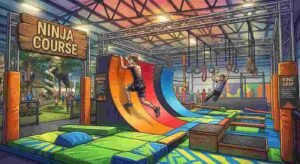
Anyone who’s watched one of those televised ninja-warrior competitions will recognize the DNA here immediately. The urban air ninja course strings together hanging bars, rotating discs, warped walls, and cargo-net climbs, all suspended above cushioned flooring in case gravity wins.
Unlike the trampoline zones, this one rewards grip strength and balance more than raw bounce — which explains why it’s such a hit with teenagers and adults chasing something that actually feels like a workout, not just play. Several locations even clock runs and post them on a leaderboard, which turns a casual visit into a friendly rivalry pretty fast.
Worth knowing: skip the socks-only approach if you can. Real shoes with grip make a noticeable difference on the warped wall especially.
Ropes Course at Urban Air
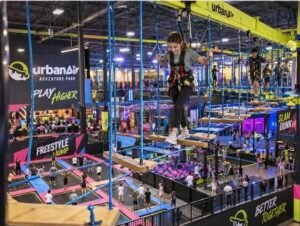
Look up, and you’ll usually spot the ropes course urban air parks build above the main floor — a network of rope bridges, swinging planks, cargo nets, and balance beams strung between elevated platforms. Everyone clips into a harness connected to an overhead safety line before setting foot on it.
Because it’s methodical rather than frantic, the ropes course tends to pull in families looking for something a notch calmer than the trampoline chaos below. It’s also one of the rare attractions where height — not bounce ability — becomes the deciding factor; taller kids and adults generally move through it with a lot less trouble.
Something to check first: most locations set a minimum height around 42–46 inches, so it’s not a given that younger siblings will be able to join.
Urban Air Basketball
Urban air basketball takes an ordinary layup and turns it into something closer to a highlight reel — players bounce off a trampoline before shooting, which naturally sends the ball (and the player) soaring higher than gravity would normally allow. Depending on the location, you’ll find either a single hoop tucked near the main arena or a small dedicated multi-hoop setup.
It’s a natural draw for kids who already play the sport recreationally, since suddenly dunking becomes possible without needing an actual growth spurt. It also happens to be one of the gentler attractions physically, which makes it a solid pick when your group spans a wide age range.
Urban Air Ball Pit
Tucked near the trampoline arena, the urban air ball pit does double duty as both a landing zone and a standalone play spot. It’s deeper than the plastic-ball pits most people remember from childhood malls — deep enough, in fact, that jumping or diving in from an elevated platform is part of the appeal.
Younger kids especially gravitate here; it’s sensory, playful, and considerably lower-impact than the slides or the ninja course. It also makes a decent rest stop for anyone who wants to stay in the action without fully committing to another round of jumping.
The Signature Thrill Rides
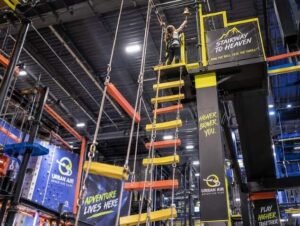
Beyond the standard lineup, most Urban Air locations reserve a few branded attractions for guests chasing something a little more intense — the kind of thing that ends up in every family’s photo roll.
Stairway to Heaven
Stairway to Heaven urban air challenges climbers to work their way up a set of suspended rungs that shift and sway under every step. The goal is simple — reach the top, ring the bell — but the moving steps make balance the real obstacle, not height. A harness clipped to an overhead line keeps things safe throughout the climb.
Leap of Faith
The Leap of Faith urban air attraction combines a tall pole or platform climb with a jump toward a suspended target — often a trapeze bar or a punching bag — followed by a controlled fall into a foam pit or onto an airbag. It’s brief, but it tests nerve more than fitness, and it’s usually the one attraction guests talk about for weeks afterward.
Let ‘Em Fly Zip Line
Let ‘Em Fly Urban Air is the park’s indoor zip line, sending riders gliding across the arena from an elevated starting platform. Compared to the ninja course or ropes course, it’s fairly low-effort—no climbing skill required, just holding on while the line does the work.
Getting the Most Out of Your Visit
- Front-load the popular rides. Stairway to Heaven and Leap of Faith tend to build the longest lines by early afternoon — hit them first.
- Alternate intensity. Swap between high-energy attractions (ninja course, slides) and calmer ones (ball pit, basketball) so kids don’t burn out an hour in.
- Check the harness-based rules before you queue. Ropes courses, Stairway to Heaven, and the zip line usually call for closed-toe shoes and have posted weight limits.
- Ask about add-on passes. A handful of locations charge separately for the ropes course or zip line, even with a standard jump pass in hand.
Mistakes First-Timers Almost Always Make
- Assuming everything is bundled into the base pass. Certain premium attractions cost extra at some locations — worth a quick check before arrival.
- Skipping the height and weight check. Kids get turned away from slides, the ropes course, and Leap of Faith more often than parents expect, typically because nobody looked at the posted limits.
- Hitting the ninja course in socks. Grip surfaces are far less forgiving without proper shoes.
- Underestimating the time needed. With this many attractions in one building, an hour rarely covers the whole list.
FAQs
1. What’s actually included with a standard Urban Air jump pass? Generally the trampoline arena, the urban air ball pit, dodgeball, and the basic obstacle zones. Premium attractions like the ropes course, Stairway to Heaven, or Let ‘Em Fly sometimes cost extra depending on the location.
2. Is there a minimum height for the urban air slides? Yes — most locations set one, mainly to keep the tube and landing area safe for riders. It varies from park to park, so check before you get in line.
3. How tough is the urban air ninja course, honestly? Somewhere between moderate and genuinely challenging, depending on the obstacle. The warped wall and rotating discs demand more grip strength and balance than the trampoline arena ever will.
4. Do I need specific shoes for the ropes course Urban Air offers? Closed-toe athletic shoes are usually required for the ropes course, Stairway to Heaven, and similar harness-based rides.
5. Is the leap of faith actually safe for kids? It’s built more with older kids and adults in mind — people reasonably comfortable with heights — since it involves a climb and a jump onto an airbag or foam pit. Height and weight limits typically apply.
6. Can toddlers use the urban air ball pit? Yes, generally — it’s one of the more toddler-friendly spots in the park, and many locations set aside a separate zone just for the youngest visitors.
7. What makes urban air basketball different from a regular court? The trampoline assist lets players jump noticeably higher toward the hoop, so dunks and high-arc shots become achievable without needing a real vertical leap.
Conclusion
Between the urban air slides, the ninja course, the ropes course, basketball, the ball pit, and the trio of signature rides — Stairway to Heaven, Leap of Faith, and Let ‘Em Fly — there’s rarely a dull stretch inside an Urban Air park. The trick to actually enjoying all of it is knowing what you’re walking into beforehand: check the height requirements, mix the intense stuff with the mellow stuff, and knock out the longer-wait attractions early. For everything else — pricing, age brackets, planning your visit — the Urban Air Ultimate Guide picks up where this one leaves off.

Expert contributor and editor at Urban Time News specializing in smart city infrastructure urban development technology and modern lifestyle trends. Focused on delivering accurate well researched and data driven insights that help readers better understand the rapidly changing urban landscape. Committed to clear balanced and useful reporting on the trends ideas, and innovations shaping modern city life.