

Introduction:
News from Balochistan often arrives in fragments an attack, a protest, a security operation, or a government announcement. Taken individually, these headlines can feel disconnected. Taken together, they tell a deeper story about a province that sits at the heart of Pakistan’s strategic ambitions and its most persistent internal challenges.
This is not just a regional issue. What happens in Balochistan has long term implications for national cohesion, economic growth, and regional geopolitics.
Why Balochistan Matters More Than Ever
Strategic Geography, Strategic Stakes
Balochistan makes up nearly half of Pakistan’s landmass and borders Iran and Afghanistan, with access to the Arabian Sea. Gwadar Port, a flagship project under the China–Pakistan Economic Corridor (CPEC), places the province at the center of regional trade ambitions.
Yet geography alone does not create stability. Without political trust and local inclusion, strategic projects risk becoming symbols of exclusion rather than progress.
A Province Rich in Resources, Poor in Outcomes
Balochistan is rich in natural gas, minerals, and coastline potential. Despite this, it remains Pakistan’s least developed province by most social indicators education, healthcare, and employment. This imbalance fuels long-standing grievances and reinforces a perception that wealth flows outward while hardship remains local.
Understanding the Security Narrative
Insurgency as a Symptom, Not the Root Cause
Militancy and periodic violence dominate headlines, but treating security as the core problem misses the bigger picture. Insurgency in Balochistan is better understood as a symptom of political alienation, economic marginalization, and weak governance.
Military responses may suppress immediate threats, but they do not resolve the underlying drivers of unrest.
The Civilian Cost of Instability
For ordinary residents, instability means disrupted education, limited job opportunities, and constant uncertainty. Each incident pushes investors away and deepens mistrust between the state and local communities.
Governance and Representation Challenges
Trust Deficit Between Center and Province
One of the most enduring issues in Balochistan is the lack of confidence in federal decision making. Policies are often perceived as top down, with insufficient local consultation. Even development initiatives struggle when communities feel excluded from planning and benefits.
Weak Local Institutions
Provincial governance suffers from capacity issues, political fragmentation, and short term policymaking. Without strong civilian institutions, sustainable development remains elusive.
Economic Development: Promise vs. Reality
CPEC and Gwadar: Opportunity With Conditions
Large-scale infrastructure projects have the potential to transform Balochistan’s economy, but only if local populations see tangible benefits jobs, education, and ownership. Otherwise, these projects risk becoming flashpoints rather than solutions.
Employment and Skill Gaps
A critical challenge is that many high skilled jobs linked to mega-projects are filled by outsiders. Without serious investment in local education and vocational training, resentment is likely to grow.
Why This News Matters Nationally and Regionally
Internal Stability Shapes External Credibility
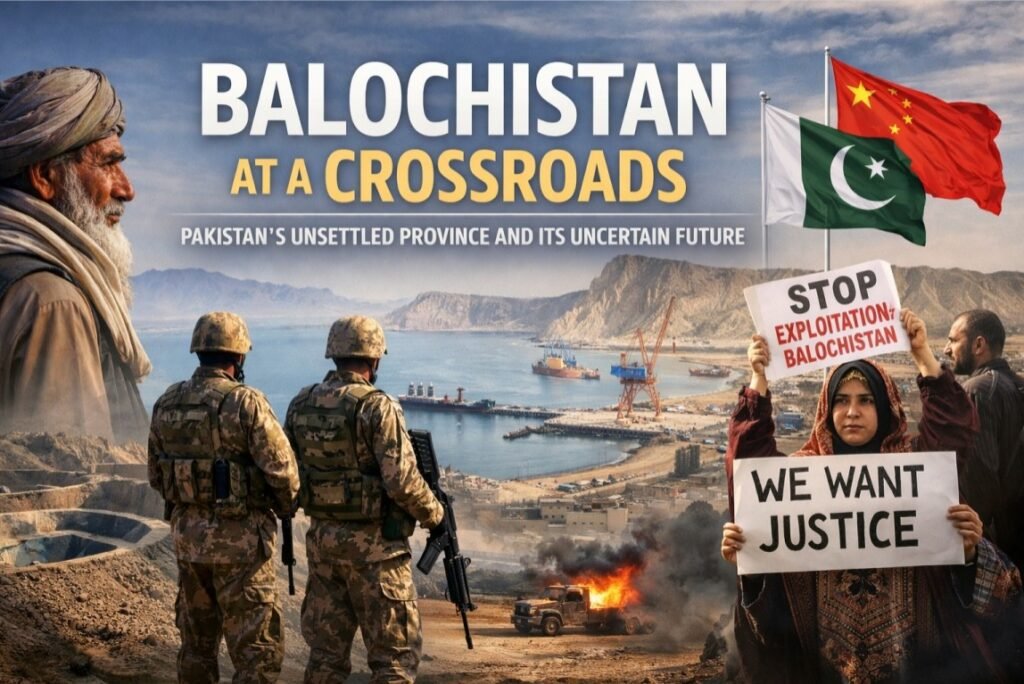
Pakistan’s ability to manage Balochistan peacefully affects how regional and global partners assess its stability. Persistent unrest raises concerns for investors, neighbors, and strategic allies.
Regional Security Implications
Given Balochistan’s borders and coastline, instability can spill over into broader regional security dynamics, affecting trade routes, migration patterns, and diplomatic relationships.
The Road Ahead: What Comes Next
From Security First to People First Policy
A lasting solution requires a shift in approach one that prioritizes political dialogue, economic inclusion, and accountable governance alongside security measures.
Listening as a Policy Tool
Engaging local leaders, civil society, and youth is not a concession; it is a necessity. Sustainable peace in Balochistan will come less from force and more from trust.
Conclusion:
Balochistan is more than a troubled province it is a test of Pakistan’s ability to balance security, development, and democratic inclusion. The choices made today will shape not only Balochistan’s trajectory but the country’s long-term stability and regional standing.