

Introduction
We present a definitive, in-depth examination of Henry Ward Beecher, one of the most influential American clergymen, orators, social reformers, and public intellectuals of the nineteenth century. Revered for his commanding sermons, progressive theology, and outspoken advocacy for abolition, social justice, and moral reform, Beecher shaped American religious thought and public discourse during a period of profound national transformation. His life and work offer a lens through which we understand the evolving intersection of faith, politics, and culture in the United States.
Early Life and Family Background
Henry Ward Beecher was born on June 24, 1813, in Litchfield, Connecticut, into the prominent Beecher family, a lineage synonymous with religious leadership and reformist zeal. His father, Lyman Beecher, was a renowned Presbyterian minister and moral crusader, whose theological rigor and reformist spirit left a lasting imprint on Henry’s worldview. Raised in an environment steeped in Calvinist theology, intellectual discipline, and moral responsibility, Beecher developed an early sensitivity to ethical questions and public service.
Educated at Amherst College and later at Lane Theological Seminary, Beecher demonstrated an exceptional talent for communication and persuasion. These formative years cultivated his distinctive approach to preaching—one that emphasized emotional resonance, practical morality, and an accessible interpretation of Christian doctrine.
Rise as a Nationally Celebrated Preacher
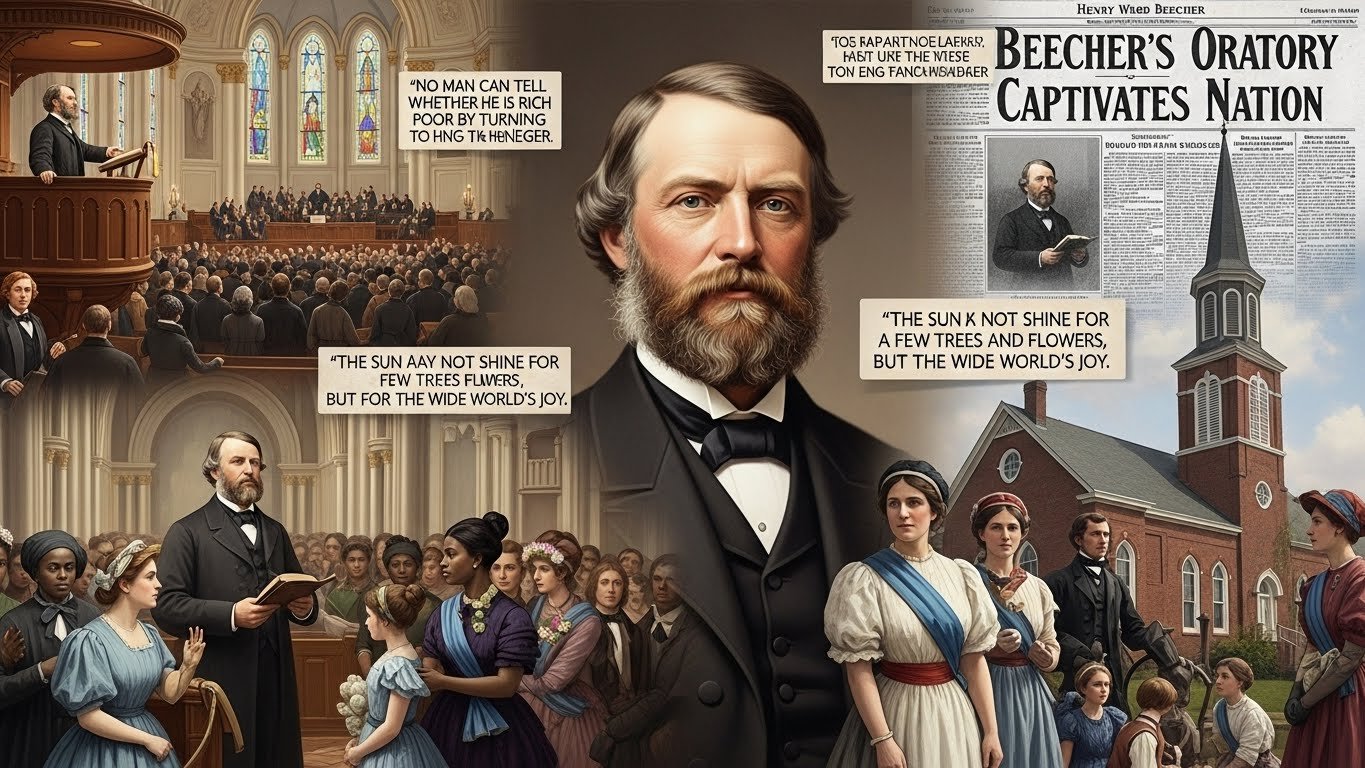
Henry Ward Beecher’s ascent to national prominence began with his appointment as pastor of Plymouth Church in Brooklyn, New York, in 1847. From this pulpit, he transformed religious oratory into a powerful medium for social engagement. His sermons, often delivered to overflowing congregations, blended theological insight, moral urgency, and rhetorical brilliance, making him one of the most widely heard voices in America.
Unlike traditional fire-and-brimstone preaching, Beecher emphasized God’s love, human dignity, and moral growth, appealing to both intellect and emotion. His sermons were frequently transcribed and published, extending his influence far beyond the walls of Plymouth Church and solidifying his reputation as a master communicator.
Advocacy for Abolition and Civil Rights
We recognize Henry Ward Beecher as a leading moral voice in the abolitionist movement. At a time when the nation was deeply divided over slavery, Beecher used his platform to condemn the institution as a profound moral evil. He supported the Underground Railroad, raised funds to purchase freedom for enslaved individuals, and publicly denounced pro-slavery ideologies.
His commitment extended beyond words. Beecher famously organized the fundraising of rifles—known as “Beecher’s Bibles”—for anti-slavery settlers in Kansas, demonstrating his belief that moral conviction sometimes required decisive action. Through sermons, lectures, and publications, he framed abolition as a Christian imperative rooted in justice and compassion.
Influence During the Civil War Era
During the American Civil War, Henry Ward Beecher emerged as a key figure in shaping Northern public opinion. His sermons reinforced the moral legitimacy of the Union cause and emphasized the necessity of preserving the nation on ethical grounds. Beecher’s influence reached international audiences when he traveled to England to counter Confederate sympathies, delivering eloquent speeches that defended the Union and reframed the war as a struggle for human freedom.
These efforts significantly contributed to shifting European public sentiment, underscoring Beecher’s role as an unofficial ambassador of American moral values during a critical historical moment.
Theological Innovation and Religious Thought
Henry Ward Beecher’s theology marked a departure from rigid Calvinism toward a more liberal Protestant perspective. He rejected doctrines that emphasized predestination and eternal punishment, advocating instead for a faith grounded in love, hope, and moral progress. Beecher believed religion should inspire ethical living and social responsibility rather than fear.
His writings explored the relationship between faith and everyday life, addressing topics such as family, work, and civic duty. By aligning spiritual belief with practical morality, Beecher helped pave the way for modern, socially engaged Christianity.
Role in Social and Cultural Reform
Beyond abolition, Beecher championed numerous reform causes, including women’s rights, temperance, and educational advancement. He supported greater participation of women in public life and advocated for moral reforms that addressed the root causes of social inequality.
As a prolific writer and editor, Beecher contributed to influential publications and authored numerous essays and books. His ability to articulate complex social issues in accessible language broadened public understanding and encouraged civic engagement across diverse audiences.
Controversies and Public Scrutiny
Despite his acclaim, Henry Ward Beecher’s life was not without controversy. In the 1870s, he became the central figure in a highly publicized adultery trial that captivated the nation. While the legal outcome did not result in a conviction, the scandal subjected Beecher to intense public scrutiny and tested his moral authority.
We acknowledge that this episode revealed the complexities of public leadership and personal conduct in an era when religious figures were held to exceptionally high standards. Nevertheless, Beecher retained the support of many followers and continued his work until his death.
Literary Contributions and Lasting Impact
Henry Ward Beecher authored numerous works that remain significant for their theological insight and cultural commentary. Titles such as “Lectures to Young Men” and “Life of Jesus the Christ” reflect his enduring commitment to accessible, morally grounded religious education. His writings continue to be studied for their rhetorical power and progressive vision.
Beecher’s influence extended to future generations of preachers, reformers, and public speakers. His integration of faith with social responsibility helped redefine the role of religious leadership in a democratic society.
Enduring Legacy of Henry Ward Beecher
We conclude that Henry Ward Beecher stands as a pivotal figure in American history whose life embodied the dynamic interplay of religion, reform, and public discourse. His unwavering commitment to justice, his innovative theology, and his unparalleled oratory left an indelible mark on the nation’s moral conscience.
Through his advocacy for abolition, his influence during the Civil War, and his contributions to religious thought, Beecher helped shape the ethical framework of modern America. His legacy endures as a testament to the power of words, conviction, and moral courage in times of profound social change.

“Expert contributor at Urban Time News, specializing in smart city infrastructure, urban development, and modern lifestyle trends. Providing data-driven insights and in-depth analysis to help readers navigate the complexities of city living. Follow for accurate, unbiased reporting on the pulse of the modern urban landscape.”