
News Elementor

RECENT NEWS

Does Red Light Therapy Tan You: A Comprehensive Scientific Analysis

Understanding Red Light Therapy and Its Purpose

Does Red Light Therapy Tan You has rapidly become a widely discussed wellness and aesthetic technology. It is commonly used in skin rejuvenation, muscle recovery, pain management, and anti-aging protocols.

We address this question with precision, clarity, and scientific accuracy. Red light therapy operates within a specific wavelength range that fundamentally differentiates it from ultraviolet-based light exposure. Understanding these distinctions is essential to separating fact from misconception.

What Causes Skin Tanning? A Biological Perspective

Skin tanning is a biological response triggered by ultraviolet (UV) radiation, specifically UVA and UVB rays. When UV radiation penetrates the skin, it stimulates melanocytes to produce melanin, the pigment responsible for darker skin tones. This process is a defensive mechanism designed to protect deeper skin layers from DNA damage.

Tanning does not occur without UV exposure. Any light source incapable of emitting UV radiation cannot initiate the melanin response required for tanning.

Does Red Light Therapy Emit UV Rays?

Does Red Light Therapy Tan You. not emit ultraviolet radiation This point is critical and non-negotiable. Red light therapy devices typically operate in the 630–660 nm (red light) and 810–880 nm (near-infrared light) wavelength ranges. These wavelengths sit far outside the UV spectrum.

Because UV radiation is the sole trigger for melanin production, and red light therapy contains zero UV output, the biological pathway required for tanning is never activated.

Can Red Light Therapy Darken Skin in Any Way?

Red light therapy does not darken the skin in the traditional sense of tanning. However, users may observe subtle visual changes that are often misinterpreted as tanning. These changes include:

  • Improved blood circulation, creating a temporary healthy glow
  • Enhanced skin hydration and elasticity
  • Reduced redness and inflammation over time
  • More even skin tone due to collagen stimulation

These effects are optical improvements, not pigment changes. The skin appears brighter, healthier, and more vibrant, but melanin levels remain unchanged.

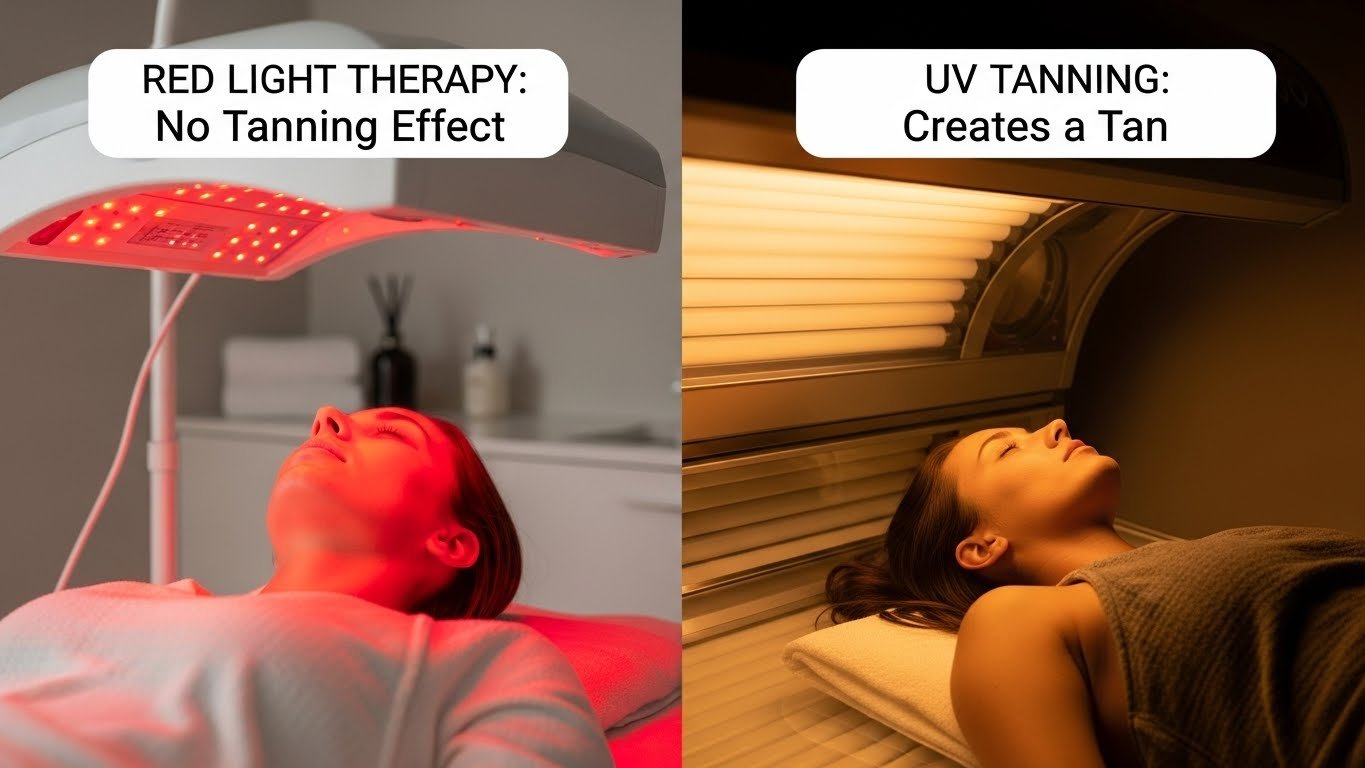
Red Light Therapy vs Tanning Beds: A Direct Comparison

The confusion often arises from the association of light-based devices with tanning beds. This comparison is scientifically inaccurate.

Tanning beds

  • Emit high levels of UVA and UVB radiation
  • Actively increase melanin production
  • Cause long-term skin damage and photoaging
  • Increase skin cancer risk

Red light therapy devices

  • Emit non-ionizing, non-UV wavelengths
  • Stimulate cellular repair and mitochondrial activity
  • Improve collagen and elastin production
  • Support skin health without DNA damage

Red light therapy is not a safer tanning alternative because it is not a tanning method at all.

Why Some People Believe Red Light Therapy Causes Tanning

This misconception stems from three main factors:

  1. Immediate skin warmth after treatment, often confused with sun exposure
  2. Enhanced circulation, leading to a flushed or radiant appearance
  3. Improved skin clarity, making natural skin tone appear more pronounced

None of these effects involve pigment alteration. Once circulation normalizes, the skin returns to its baseline color without any lasting darkening.

Scientific Evidence on Red Light Therapy and Melanin Production

Peer-reviewed dermatological studies consistently confirm that red and near-infrared light do not stimulate melanocytes. Instead, they target fibroblasts and mitochondria, increasing adenosine triphosphate (ATP) production. This cellular energy boost accelerates tissue repair and collagen synthesis.

In clinical environments, red light therapy is frequently used to treat hyperpigmentation, not cause it. It supports skin normalization rather than pigment intensification.

Is Red Light Therapy Safe for All Skin Tones?

Red light therapy is considered safe and effective across all Fitzpatrick skin types, from very fair to deeply pigmented skin. Unlike UV-based treatments, red light therapy does not increase the risk of:

  • Sunspots
  • Melasma
  • Post-inflammatory hyperpigmentation
  • Uneven tanning

This makes it especially valuable for individuals who avoid sun exposure due to pigmentation concerns.

Can Red Light Therapy Be Used Alongside Tanning?

While red light therapy does not cause tanning, some individuals combine it with tanning routines for skin recovery purposes. Red light therapy is often used to:

  • Reduce UV-induced inflammation
  • Improve moisture retention after sun exposure
  • Support collagen repair following UV stress

It is important to note that red light therapy does not enhance or accelerate tanning results. It serves only as a supportive skin care modality, not a pigment enhancer.

Red Light Therapy for Skin Brightening and Tone Correction

One of the most documented benefits of red light therapy is skin tone refinement. Regular use can lead to:

  • Reduced dullness
  • Improved texture
  • More even complexion
  • Enhanced natural luminosity

Long-Term Skin Effects of Red Light Therapy

Consistent red light therapy usage supports long-term skin health by:

  • Increasing collagen density
  • Strengthening the skin barrier
  • Reducing fine lines and wrinkles
  • Enhancing cellular turnover

These outcomes contribute to a youthful, refreshed appearance without altering skin color. There is no cumulative darkening effect, even with prolonged use.

Does Red Light Therapy Replace Sun Exposure for Vitamin D?

Red light therapy does not stimulate vitamin D synthesis, as vitamin D production requires UVB radiation. Users seeking vitamin D benefits must rely on dietary sources or supplements, not red light therapy.

Final Verdict: Does Red Light Therapy Tan You?

Does Red Light Therapy Tan You. It contains no ultraviolet radiation, does not stimulate melanin production, and does not alter skin pigmentation. Any perceived color changes are temporary visual enhancements resulting from improved circulation and skin health.

Red light therapy stands as a Does Red Light Therapy Tan You. designed to support cellular repair, collagen production, and overall skin vitality. It offers the benefits of light-based therapy without the risks associated with tanning or UV exposure.

Understanding Red Light Therapy and Its Purpose

Does Red Light Therapy Tan You has rapidly become a widely discussed wellness and aesthetic technology. It is commonly used in skin rejuvenation, muscle recovery, pain management, and anti-aging protocols.

We address this question with precision, clarity, and scientific accuracy. Red light therapy operates within a specific wavelength range that fundamentally differentiates it from ultraviolet-based light exposure. Understanding these distinctions is essential to separating fact from misconception.

What Causes Skin Tanning? A Biological Perspective

Skin tanning is a biological response triggered by ultraviolet (UV) radiation, specifically UVA and UVB rays. When UV radiation penetrates the skin, it stimulates melanocytes to produce melanin, the pigment responsible for darker skin tones. This process is a defensive mechanism designed to protect deeper skin layers from DNA damage.

Tanning does not occur without UV exposure. Any light source incapable of emitting UV radiation cannot initiate the melanin response required for tanning.

Does Red Light Therapy Emit UV Rays?

Does Red Light Therapy Tan You. not emit ultraviolet radiation This point is critical and non-negotiable. Red light therapy devices typically operate in the 630–660 nm (red light) and 810–880 nm (near-infrared light) wavelength ranges. These wavelengths sit far outside the UV spectrum.

Because UV radiation is the sole trigger for melanin production, and red light therapy contains zero UV output, the biological pathway required for tanning is never activated.

Can Red Light Therapy Darken Skin in Any Way?

Red light therapy does not darken the skin in the traditional sense of tanning. However, users may observe subtle visual changes that are often misinterpreted as tanning. These changes include:

  • Improved blood circulation, creating a temporary healthy glow
  • Enhanced skin hydration and elasticity
  • Reduced redness and inflammation over time
  • More even skin tone due to collagen stimulation

These effects are optical improvements, not pigment changes. The skin appears brighter, healthier, and more vibrant, but melanin levels remain unchanged.

Red Light Therapy vs Tanning Beds: A Direct Comparison

The confusion often arises from the association of light-based devices with tanning beds. This comparison is scientifically inaccurate.

Tanning beds

  • Emit high levels of UVA and UVB radiation
  • Actively increase melanin production
  • Cause long-term skin damage and photoaging
  • Increase skin cancer risk

Red light therapy devices

  • Emit non-ionizing, non-UV wavelengths
  • Stimulate cellular repair and mitochondrial activity
  • Improve collagen and elastin production
  • Support skin health without DNA damage

Red light therapy is not a safer tanning alternative because it is not a tanning method at all.

Why Some People Believe Red Light Therapy Causes Tanning

This misconception stems from three main factors:

  1. Immediate skin warmth after treatment, often confused with sun exposure
  2. Enhanced circulation, leading to a flushed or radiant appearance
  3. Improved skin clarity, making natural skin tone appear more pronounced

None of these effects involve pigment alteration. Once circulation normalizes, the skin returns to its baseline color without any lasting darkening.

Scientific Evidence on Red Light Therapy and Melanin Production

Peer-reviewed dermatological studies consistently confirm that red and near-infrared light do not stimulate melanocytes. Instead, they target fibroblasts and mitochondria, increasing adenosine triphosphate (ATP) production. This cellular energy boost accelerates tissue repair and collagen synthesis.

In clinical environments, red light therapy is frequently used to treat hyperpigmentation, not cause it. It supports skin normalization rather than pigment intensification.

Is Red Light Therapy Safe for All Skin Tones?

Red light therapy is considered safe and effective across all Fitzpatrick skin types, from very fair to deeply pigmented skin. Unlike UV-based treatments, red light therapy does not increase the risk of:

  • Sunspots
  • Melasma
  • Post-inflammatory hyperpigmentation
  • Uneven tanning

This makes it especially valuable for individuals who avoid sun exposure due to pigmentation concerns.

Can Red Light Therapy Be Used Alongside Tanning?

While red light therapy does not cause tanning, some individuals combine it with tanning routines for skin recovery purposes. Red light therapy is often used to:

  • Reduce UV-induced inflammation
  • Improve moisture retention after sun exposure
  • Support collagen repair following UV stress

It is important to note that red light therapy does not enhance or accelerate tanning results. It serves only as a supportive skin care modality, not a pigment enhancer.

Red Light Therapy for Skin Brightening and Tone Correction

One of the most documented benefits of red light therapy is skin tone refinement. Regular use can lead to:

  • Reduced dullness
  • Improved texture
  • More even complexion
  • Enhanced natural luminosity

Long-Term Skin Effects of Red Light Therapy

Consistent red light therapy usage supports long-term skin health by:

  • Increasing collagen density
  • Strengthening the skin barrier
  • Reducing fine lines and wrinkles
  • Enhancing cellular turnover

These outcomes contribute to a youthful, refreshed appearance without altering skin color. There is no cumulative darkening effect, even with prolonged use.

Does Red Light Therapy Replace Sun Exposure for Vitamin D?

Red light therapy does not stimulate vitamin D synthesis, as vitamin D production requires UVB radiation. Users seeking vitamin D benefits must rely on dietary sources or supplements, not red light therapy.

Final Verdict: Does Red Light Therapy Tan You?

Does Red Light Therapy Tan You. It contains no ultraviolet radiation, does not stimulate melanin production, and does not alter skin pigmentation. Any perceived color changes are temporary visual enhancements resulting from improved circulation and skin health.

Red light therapy stands as a Does Red Light Therapy Tan You. designed to support cellular repair, collagen production, and overall skin vitality. It offers the benefits of light-based therapy without the risks associated with tanning or UV exposure.

It is a long established fact that a reader will be distracted by the readable content of a page when looking at its layout. The point of using Lorem Ipsum is that it has a more-or-less normal distribution of letters, as opposed to using ‘Content here, content here’, making it look like readable English. Many desktop publishing packages and web page editors now use Lorem Ipsum as their default model text, and a search for ‘lorem ipsum’ will uncover many web sites still in their infancy.

It is a long established fact that a reader will be distracted by the readable content of a page when looking at its layout. The point of using Lorem Ipsum is that it has a more-or-less normal distribution of letters, as opposed to using ‘Content here, content here’, making it look like readable English. Many desktop publishing packages and web page editors now use Lorem Ipsum as their default model text, and a search for ‘lorem ipsum’ will uncover many web sites still in their infancy.

The point of using Lorem Ipsum is that it has a more-or-less normal distribution of letters, as opposed to using ‘Content here, content here’, making

The point of using Lorem Ipsum is that it has a more-or-less normal distribution of letters, as opposed to using ‘Content here, content here’, making it look like readable English. Many desktop publishing packages and web page editors now use Lorem Ipsum as their default model text, and a search for ‘lorem ipsum’ will uncover many web sites still in their infancy.

Urban Time News

RECENT POSTS

CATEGORIES

Leave a Reply

Your email address will not be published. Required fields are marked *

OUR MISSON

Urban Time News delivers timely news, trends, and insights across business, technology, lifestyle, fashion, and culture. Stay informed with trusted stories from around the world.

Copyright UrbanTimeNews. 2026